Background
Prison visits are part and parcel of consular work. You check on the prisoner’s health and make sure they are being treated fairly. You pass on messages to family and listen to their complaints. You do it for everyone, whatever they are accused of.
In 2009 I made one prison visit that tested that principle more than most, because the man behind bars had fraudulently taken my money, and I found out that I was to be the consular officer who would deal with his case.
This particular UK national had been arrested by the Egyptian authorities in Hurghada on a charge of fraud and theft. The fraud part was the selling of off-plan apartments to foreigners, taking large deposits from them, pocketing the money and not completing any of the work. The theft part was the non-payment of funds to the local Egyptian builders contracted to complete the work, which amounted to many hundreds of thousands of pounds.
As in the majority of such detention cases of UK nationals overseas, the embassy was notified by the local Ministry of Foreign Affairs of the arrest of the individual, the charge and where they were being held. As a matter of formality, the Ministry would also usually grant the embassy consular access to the prisoner for a welfare prison visit, and this is what the Egyptians granted us permission to do.
The Fraud I Didn’t See Coming
Like so many other Britons, I had been taken with the idea of a place on the Red Sea. So, coming towards the end of my posting in Tehran, I started doing some research. I was drawn to Hurghada in Egypt as I knew by then that my next nine-month attachment would be to the consular section at our embassy in Cairo. This was the ideal place to be in order to check everything out on the ground.
I contacted the UK company that was developing the off-plan site with local Egyptian builders, and they sent me brochures and other material about the scheme and the general area. To cut a long story short, I picked out the apartment I was interested in and paid a small holding deposit of £2,000 to reserve it. Alarm bells should have sounded then, as the company wanted me to pay a full deposit before proceeding, which would have amounted to £30,000 or more, and they were quite adamant about it.
I refused and told them I would soon be working at our embassy in Cairo and would at some stage be heading to Hurghada to view the project before paying any more money up front. Then, after sending them this message, radio silence. Nothing. All efforts to contact them failed.
It was only just before leaving Tehran for Cairo that I learned the company had folded, leaving many would-be buyers bereft and out of pocket, myself included.
It was a strange feeling to be a victim of exactly the kind of problem you spend your working life helping other people with. I had sat across the desk from British nationals who had lost money abroad, listened, and explained what the Embassy could and could not do. Now I was in the same boat, and I knew precisely how little anyone could do for me.
So this consular visit was more than just a routine check-in. It showed the complexities consular staff can face in a case like this, thankfully rare and pretty unique.
Tough Decision
For my own peace of mind, before making the trip to Hurghada, I spoke with my line manager about a possible conflict of interest in carrying out this consular visit. Given the personal aspect of the case, it was a crucial discussion. He was very understanding and left the final decision to me whether to go ahead or not.
Options were pretty slim at that time: the only other consular-qualified officer at post who could have taken the case on was on leave and would not be back for a further week.
That would leave our prisoner in Hurghada in consular limbo for that amount of time, which was not best practice.
I told my line manager I would take the visit, be totally professional about it and not tell the prisoner that I had been one of his victims.
As if that were not enough, around the same time we received a note from the Egyptian Foreign Ministry stating that the Governor of Luxor had ordered the city’s foreigners’ cemetery to be moved, graves and all, to a new site in the desert, and he had given us a three-month deadline to complete the job.
So when the time came to go to Luxor, it made sense to kill two birds with one stone: I would drive on to Luxor after Hurghada to liaise with our man on the ground, the Honorary Consul, and find out exactly what was happening.
Egypt: Moving The Dead Luxor 2009
Normally I would have flown from Cairo to Luxor. This time, a road trip it was to be.
The Road to Hurghada
It is a long drive, around 450 kilometres, east from Cairo to the Gulf of Suez and then south down the coast, with the sea on one side and the desert on the other. Plenty of time to think about the man at the end of it.
Beyond the narrow coastal strip, the landscape was nothing but sand, rock and heat haze for mile after mile. And the heat was oppressive. The car had air conditioning, and it made precious little difference.
The road was dotted with checkpoints, some fixed and some random, manned by police and in some instances by the military. At each one we slowed, stopped, waited and were waved on. Of course, driving in a CD-plated vehicle pretty much ensured a speedy process. It was a reminder that in Egypt in those years, security on the roads between cities was taken very seriously indeed.
To break the monotony of the journey, and on the recommendation of my driver, we stopped a couple of times at small roadside tea stalls. He knew the road and he knew where to stop. A glass of hot, sweet tea in the shade, in the middle of nowhere, was one of the small pleasures of travelling in Egypt, and on that journey it was very welcome.

Driving down to Hurghada gave me time to reflect on the changing landscape of Egyptian tourism. The resorts, vibrant with life and energy, hid the serious problems underlying real estate investment there.
I recalled how the allure of sun-soaked beaches and luxury accommodation had drawn so many people, unaware of the potential pitfalls and scams that lurked beneath the surface. I was one of them.
Hurghada had grown from a fishing village into one of Egypt’s biggest resorts. In the mid-2000s, it was also a magnet for British buyers looking for a place in the sun. New apartment blocks were going up everywhere, sold off-plan to foreigners who paid deposits up front and waited for keys that, in too many cases, never came.
The Prison
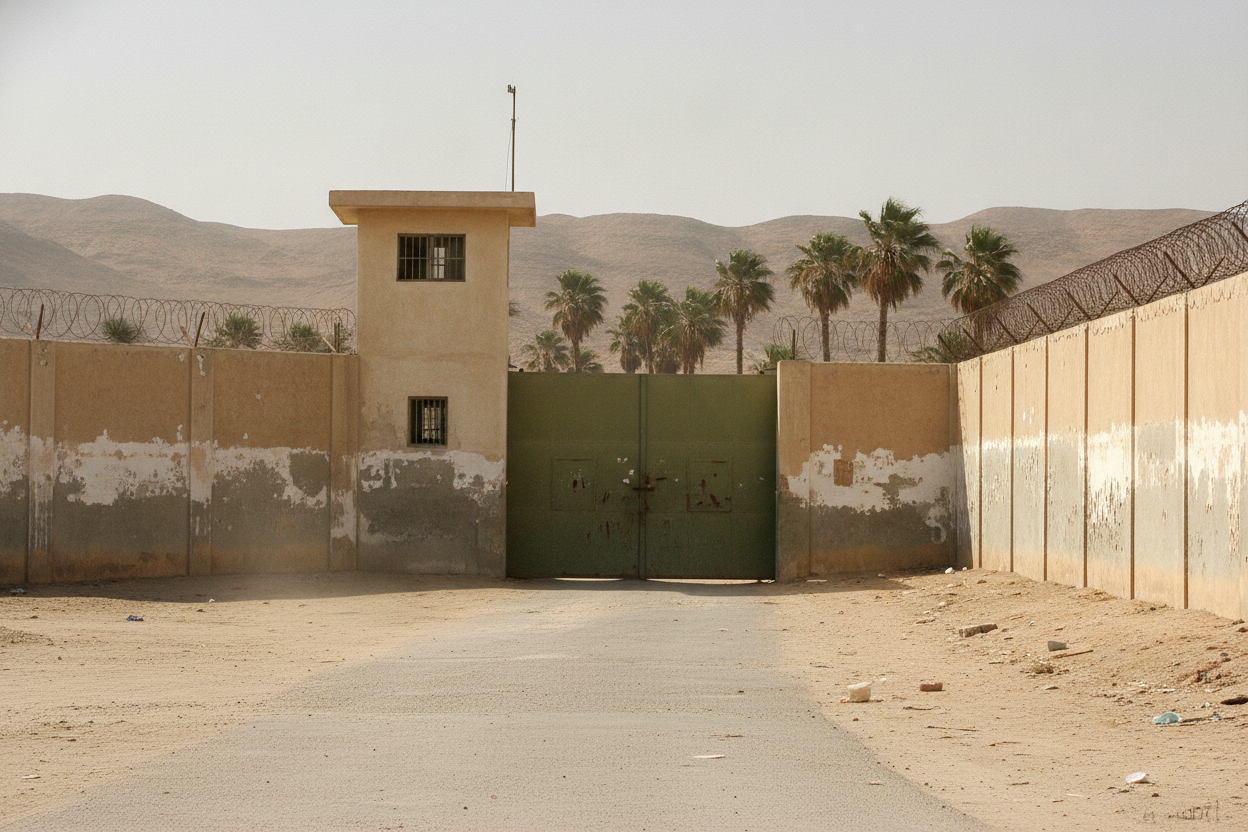
After an uneventful drive we reached Hurghada. My driver, who doubled as interpreter, pulled us into the prison. There, I was met by the Director, who had been forewarned of my consular visit.
He led me to his spacious office and briefed me on the condition of the prisoner, saying that he was receiving treatment that surpassed that of local Egyptian prisoners.
He was well aware of the thousands of foreign tourists who visited Hurghada annually. Special measures decreed by the Ministry of Justice in Cairo had accordingly been put in place to deal with foreigners who had the misfortune to end up in his establishment. Indeed, he said, as per his instructions from Cairo, all foreigners were housed together, separately from the local Egyptian inmates.
Once he had finished, he summoned a couple of guards and told them to take me to the cellblock where my prisoner was being housed. The cell was large, well lit and ventilated, with a small number of bunk beds and a larger number of futon-type mattresses on the floor. In the corner was a large trough-type sink where several inmates could carry out their ablutions at the same time, and next to that was the dreaded, unscreened “long drop” Egyptian toilet. No privacy here!
However, I was not totally convinced. It would not be beyond the realms of possibility that the Director was showing me a “model” or “show” cell and that my prisoner was in fact housed elsewhere in the prison in less than satisfactory conditions. When I raised my concerns with the Director, he assured me this was not the case and said he had regular inspections from Justice officials from Cairo, who were satisfied he was carrying out their instructions when it came to foreigners.
Face to Face
After the cellblock visit, I was shown into a small side room where my prisoner was seated. The guards left and we were alone for the meeting.
He appeared in good shape and was more than willing to tell his story. First of all he complained about the conditions and then the food. He said he was housed in a filthy 50-man cell with Egyptian criminals, murderers and rapists.
I told him that the Director had shown me a cell and described what I had seen. He said that this was a lie. I answered that I had noted his complaint and would bring it up with the Director before I left the prison.
At this, he appeared somewhat reassured. He insisted that he was innocent and that the real villain was the overall boss of the company he worked for. He went on to say he was nothing more than a scapegoat, not the villain of the piece he was being made out to be. I listened while taking notes as he recounted his side of the story, filled with justifications and regrets. It was galling to hear these excuses and his promises that, if freed, he would do everything in his power to get justice and compensation for the prospective buyers who had been fleeced.
Here, I really had to hold my tongue. The more I listened to him, the angrier I got. I had planned to buy one of those apartments myself, and this sad specimen had defrauded me along with everyone else. Thankfully, I kept my anger in check, remembering my chat with my line manager in Cairo about remaining professional.
At last he finished. I then laid out exactly the sort of services we could provide for him. I politely took note of his concerns and told him I would be monitoring his case. I told him I would arrange for English-speaking local lawyers to contact him, and send him some toiletries and books if he wanted them. That is exactly what any consular officer would say to any British prisoner banged up in a foreign land, and exactly what I would have said to anyone else. Consular staff cannot get people out of prison, interfere in another country’s legal process or take sides on guilt or innocence. Our job was to make sure British nationals were treated fairly and humanely, and that is all. It is a job you have to do the same way for everyone. Including, it turns out, the man who had your deposit.
Overall, our interview lasted about 45 minutes. At the end, the guards were summoned and he was escorted back to his cell.
Before leaving the prison, I had a final meeting with the Director and raised the prisoner’s complaints about the conditions. Of course, he denied the prisoner’s version. I told him that I would be writing a visit report (standard practice) and a copy would be sent to the Ministry of Justice in Cairo.
Onward to Luxor
With the prison visit done, my driver and I drove into town and had a quick pizza before jumping back into the vehicle and heading south to Luxor. A very different task was waiting there: a meeting with the Governor, Samir Farag, a former Army General who wanted around 92 graves, some more than a century old, moved out into the desert within three months.
It was roughly another 290 kilometres. The road ran south along the coast to Safaga, then turned inland across the Eastern Desert to Qena on the Nile, before following the river south to Luxor. From the Red Sea to the river, it crossed the empty, rocky spine of the country. By the time we reached Luxor, we had covered something like 740 kilometres since leaving Cairo.
It was quite a trip. First a prisoner who had my money, then a Governor who wanted the dead moved. Nobody ever said consular life was dull.
I never did find out what happened to my prisoner in the long term, as several months later my attachment in Cairo was over and I had been posted to Senegal on another attachment. The whole case seemed to disappear into a black hole of legal limbo with no satisfactory outcome or resolution. I suppose in the end I was lucky. I had only paid a small holding deposit, not the tens of thousands of pounds paid by other investors, but it still rankled with me.
Looking back, I am proud of that visit in Hurghada. The job asks you to be fair to everyone, not just those you like. And on that day, with every reason not to be, I was.
© Copyright 2026 James Warren
Background sources:
- Hurghada history: Wikipedia; British visitors and freehold: Gulf News
- Buying property in Egypt: GOV.UK guidance
- What consuls can and cannot do: GOV.UK, arrested or in prison abroad, FCDO Egypt prisoner pack
- Egyptian detention conditions: Human Rights Watch World Report 2010, Amnesty International 2010