The only US Navy ship you need a North Korean visa to visit
Scene Setter:
During my three years at the British Embassy in Pyongyang between 2001 and 2004, visitors were a rare commodity. The embassy compound, shared with the Germans and Swedes, did not see a steady stream of guests. Getting a visa was a long and tortuous process. Once someone did make it in, the next problem was what on earth to show them. In a city where almost every outing was controlled, choreographed, and monitored, the list of places I could take a visitor was very short indeed. This was especially true considering the restrictions placed on us by the North Korean (NK) authorities.
Understanding the unique dynamics of the NK regime was and still is crucial for anyone intending to visit.
Life In North Korea As A Foreigner Surviving 3 Years
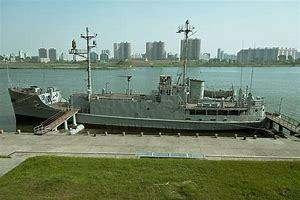
One of the few places to visit was the USS Pueblo: an American spy ship captured by the North Koreans in 1968. It is still held in Pyongyang as a trophy of their “victory” over the United States. To arrange “official” visits for foreigners, I first needed the approval of NK officials at their foreign ministry. Because the Pueblo came under the control of the NK military, I required their approval as well (here I did have a small modicum of personal contact, see link below). Once everything was approved, I arranged private tours of the ship for embassy staff and for the handful of visitors we had. During my three years in Pyongyang, I arranged visits to the ship four times. Although it was a long and sometimes complicated affair in order to get permission, I feel the experience our few visitors received was appreciated. As promised in my earlier post, North Korea Military Work With British Diplomat, this is the Pueblo story.
The Pueblo Incident:
On 23 January 1968, the USS Pueblo, a US Navy intelligence gathering vessel, was operating off the North Korean port of Wonsan when it was intercepted by North Korean patrol boats and fighter aircraft. The Americans maintained the ship was in international waters; the North Koreans insisted it had strayed into their territory. The Pueblo was fired upon, one crewman, Fireman Duane Hodges, was killed, and the ship was boarded and taken into Wonsan.
The remaining 82 crew members, including their commander, Lloyd Bucher, were held captive for eleven months, during which they were beaten and coerced into signing “confessions”. They were finally released on 23 December 1968, walking one by one across the Bridge of No Return at Panmunjom, after the United States signed a written apology which it publicly repudiated at the very same moment.
The crew went home. The ship did not. The Pueblo remains a commissioned vessel of the US Navy, still in North Korean hands. After years at Wonsan, it was moved to Pyongyang and moored on the Taedong River, where I came to know it. It has since been moved again and now sits outside the war museum in the city.
(Image courtesy of warhistoryonline)
Whenever we had a visitor—whether a colleague from London or our embassy in Beijing,, a journalist, a family member, or someone on official business—I always faced the same dilemma. The standard tourist circuit of monuments, statues, and the Juche Tower could be completed in a day. Everything outside of this required permission, which was rarely granted. A visitor wanting to see something of the “real” North Korea was going to be disappointed. However, I could at least try to give them something memorable.
This is where I think my previous relationship with the NK military on a different project possibly paid off. As I described in the RAF pilot post, I worked closely for some six months with a Senior Colonel and his team, and I think that this liaison helped somewhat in easing the permission process. Alongside these Pueblo visits, the NK military would also actively assist in arranging escorted trips to the DMZ at Panmunjom for our embassy visitors. In a country where foreigners were kept at arm’s length from almost everything, that was no small favour.

On Board With A Scripted Guide:
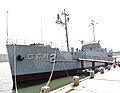
On arrival, we would be met by our guide who spoke perfect English. Each time, she was a very well turned out young lady, invariably in military uniform and she took charge of the visit. It was very much a performance. The tour began with a short film presenting the capture as a heroic defence of the motherland against “American imperialist aggressors”, followed by a walk through the ship itself.
(Image courtesy of John Pavelka}
We were shown bullet holes in the hull and superstructure, each one helpfully marked and circled for our attention with red paint. The guide pointed out the spot where the only crewman to die was killed, which was the most uncomfortable part of the tour. Throughout the ship, documents and photographs were on display, including copies of the crew’s signed confessions and the American apology, all presented as proof that the NK version of events was the only true one.
In addition to this, we would be shown the cramped intelligence spaces where cipher gear and documents were displayed. Meanwhile, a propaganda film played continuously in a loop in the wardroom.
There was no room for nuance. The ship according to NK was a spy ship, it had violated NK waters (which the Americans always denied), and the crew had freely admitted their crimes (which they later described as having been beaten out of them). Any question that strayed from the script was met with a polite smile and a repeat of the script. The coerced nature of the confessions and the repudiation of the apology never made it into the narrative.
On two of the four visits, the guide introduced us to a much be-medalled elderly gentleman dressed in a crisp white naval uniform. She explained to us that he was one of the heroic boarding party that had captured the Pueblo. The man never spoke, just stood there with a fixed smile on his face. Whether he was one of the NK participants in the event, this being North Korea, who knows?
After a couple of these visits, the same speech given by the guide just washed over me, so I came to enjoy watching my visitors reactions instead: the polite nods, the raised eyebrows exchanged behind the guide’s back, and the dawning realisation of just how firmly the history had been written for them.
An Awkward Position:
It was always a slightly surreal experience. Here was a British diplomat showing his guests around a captured American warship whose crew had been held and mistreated. The Americans had no embassy in Pyongyang and could not visit their own ship. Meanwhile, we, as their allies, were given the time and courtesy of being able to tour the vessel.
I was well aware that the North Koreans saw these visits as a chance to tell their story to Westerners. The courtesy shown to us served their purposes as much as ours. However, in a posting where opportunities to show visitors anything meaningful were scarce, the Pueblo provided a rare, albeit heavily edited, glimpse into how North Korea perceives its own history and its enduring hostility towards the United States. Most of my guests left the ship feeling it was the highlight of their trip, although rarely for the reasons our guide intended.
For more on the visits the military arranged for us to the DMZ and how they came about, see North Korea Military Work With British Diplomat.
The Pueblo today
In late 2012, the ship disappeared again, this time a short distance overland and by water to the Pothong River (a tributary of the Taedong River still in Pyongyang). It was moved beside the rebuilt Victorious Fatherland Liberation War Museum. Freshly painted, it was unveiled as the centrepiece in July 2013 for the 60th anniversary of the armistice, which North Korea marks as “Victory Day”.
As of late 2026, Pueblo is still moored on the Pothong River in central Pyongyang, part of the Victorious Fatherland Liberation War Museum. She is the only US Navy ship held by a foreign government. The Navy has never decommissioned her, making her its second-oldest commissioned ship after USS Constitution.
A live symbol. For Pyongyang, she is proof that it humbled the United States. She still features in its rhetoric. In January 2023, the party newspaper Rodong Sinmun warned that a “second Pueblo” entering its waters would bring the destruction of the enemy’s entire territory.
Calls for return. The US has repeatedly demanded her back. Congress has seen several resolutions. Before the 2018 Trump–Kim summit, some conservatives urged the President to make her return part of any deal. Surviving crew members say her return would give them peace of mind; several have said they do not expect to see it.
The legal reckoning
Crew members and their families have won three major judgments against North Korea in US federal courts, totalling more than $2.7 billion. North Korea never appeared in any of them, and almost none of the money has been collected. The suits rely on the exception to sovereign immunity for state sponsors of terrorism. North Korea’s return to the US terrorism list in November 2017 opened the way for larger cases. In the 2021 case, the court set a baseline of $10,000 for each of the 335 days in captivity, or $3.35 million per man, with individual suffering added. The 2026 judgment was formally served on North Korea in October 2026. Collection remains difficult: North Korea has few reachable assets abroad, so plaintiffs must hunt for funds that can be seized.
In the 2021 case, the court set a baseline of $10,000 for each of the 335 days in captivity, or $3.35 million per man, adding to it for individual suffering. The 2026 judgment was formally served on North Korea in October 2026. Collection remains difficult: North Korea has few reachable assets abroad, so plaintiffs must hunt for funds that can be seized.
Sources
- Naval History and Heritage Command, H-Gram 014: 50th anniversary of the seizure of USS Pueblo
- History.com, “The capture of the USS Pueblo”
- Washington Times, visit to the Pueblo in Pyongyang, 2005
- NK Economic Watch, “Pueblo moved to war museum” (2012–13)
- Mitchell Silberberg & Knupp, $404.55 million judgment (2026)
- Korea Herald, ruling served on North Korea (Oct 2026)
© Copyright 2026 James Warren