
A Message from the Ministry
Some weeks it is lost passports and stranded tourists. Some weeks it is prison visits. And some weeks, a message lands on your desk that no amount of training could have prepared you for.
Thus it was In 2009, the Egyptian Ministry of Foreign Affairs in Cairo contacted the British Embassy with exactly that kind of message. The Governor of Luxor wanted the city’s foreigners’ cemetery moved. Not just the headstones and the railings. The residents too!
The message from the Egyptian Ministry of Foreign Affairs in Cairo was not just any message; it was about the future of Luxor, a city steeped in the history of Egypt. The Governor of Luxor aimed to improve the city, making it more appealing for tourists interested in Egypt’s rich past.

The Governor’s vision for Luxor was part of a larger narrative about Egypt’s place in the world, where ancient sites must coexist with new developments.
A message like that needed checking before anyone acted on it. So I picked up the phone to our Honorary Consul in Luxor, Ehab Gaddis, the man on the ground who would know exactly what the Governor had in mind.
Ehab confirmed it. The Governor, Dr Samir Farag, wanted every grave in the foreigners’ cemetery dug up and moved to a new site in the desert, some 20 kilometres outside the city. And he wanted it done quickly within 3 months!
The General Who Ran Luxor.
To understand why the cemetery was suddenly in the way, you needed to understand the man who wanted it gone.
Samir Farag was a former Egyptian Army General. President Hosni Mubarak had appointed him Governor of Luxor in 2004, with a clear mission: restore the city’s ancient sites and turn Luxor into a world-class tourist destination. Farag took that mission very seriously indeed, and he ran the city the way a general runs a campaign.
There was no way that this could not have been carried out successfully without our man on the ground Ehab Gaddis. His role as the Honorary Consul in Luxor highlighted the importance of local knowledge in navigating the intricacies of life in Egypt especially Luxor and in more importantly dealing with the Governor.
In Egypt and in many of the countries the UK has diplomatic representation, Honorary Consuls are vital as they bridge gaps between nations and cultures, especially during sensitive operations such as these.
The Governor’s master plan was enormous. It looked decades ahead, to 2030, and its aim was nothing less than to make Luxor the largest open-air museum in the world. Roads were to be widened. Modern buildings close to the temples were cleared. A new resort area was planned that would double the number of hotel rooms in the city.
The centrepiece was the Avenue of Sphinxes. In pharaonic times this processional way, around 2.7 kilometres long, linked the great temples of Karnak and Luxor. Over the centuries it had disappeared beneath silt, soil and then houses. Farag’s plan was to dig it all out again. That meant demolishing whole streets of homes. Families were offered compensation, a new flat or a cash payment, and moved out, often to new districts on the edge of the desert.
Not everyone admired his methods. Critics accused him of wanting to wind the city back to the age of the pharaohs and sweep away everything that had come since. Farag was unapologetic. He told one newspaper that the city would remove anything standing in the way of development, even if it was a mosque or a church.
The foreign cemetery’s history mirrored the broader narrative of Egypt’s engagement with the international community, showcasing the diverse tapestry of lives intertwined with this land.
A small walled cemetery full of long-dead Europeans was never going to stand in his way for long.
Three Months, No Compromises
Then came the deadline. The whole project had to be completed within three months. If it was not, the Governor would go ahead and oversee the relocation himself. There was no room for negotiation and no compromise on offer. Egyptian bureaucracy in action, with a General’s sense of urgency on top.
Needless to say, this did not go down well at the Embassy. True to diplomatic procedure, and on the instructions of my Ambassador, I went to the Ministry of Foreign Affairs to register our concerns formally. The answer was polite but firm. The Governor was within his legal rights. The land the cemetery stood on belonged to the city, and the beautification of Luxor had the strong backing of the government in Cairo.
The Ministry of Culture also had a stake in Luxor’s transformation, so I met their representatives too. They did not try to talk me out of anything. Instead they made a practical suggestion: the best way forward was to go to Luxor and work directly with Ehab and the Governor.
The die was cast. Protest had run its course. The question now was not whether the cemetery would move, but how to make sure it was done properly.
Our Man in Luxor
Therefore, Ehab Gaddis was about to become the most important person in this story, so it is worth explaining what an Honorary Consul actually is.
The Embassy in Cairo could not have a full-time diplomat in every city in Egypt. Instead, in places like Luxor, the British government appointed an Honorary Consul. This is a voluntary role, usually held by a well-connected local figure, recognised under the Vienna Convention on Consular Relations. Honorary Consuls work under the supervision of a career post, in this case the consular section in Cairo. Their main job is helping British nationals who get into difficulty in their area.
In a tourist city like Luxor, that meant the usual consular fare: lost passports, hospital admissions, the occasional arrest and, sadly, deaths. In ordinary times the role took up a few hours a week. What Ehab had going for him was the thing no diplomat flying in from Cairo could match: he knew the city, he knew the people who ran it, and they knew him.
Thus, the arrangement for the cemetery took shape quickly. The plan would be, I would coordinate from Cairo, dealing with the ministries, the other embassies and London. Ehab would be our eyes, ears and voice on the ground in Luxor, working with the Governor’s office.
The Residents
The Foreigners’ Cemetery sat in the centre of Luxor, close to the Nile and the great archaeological sites. It dated from the late 19th and early 20th centuries, the age when Luxor became a winter retreat for wealthy Europeans and a magnet for archaeologists. Expatriates, travellers, diplomats and Egyptologists who died in the region were buried there. By 2009 it held around 92 graves.
One grave above all showed what the place meant. It belonged to Ernest Harold Jones.
Harold Jones was born in Barnsley, South Yorkshire, in 1877, to Welsh parents. He trained as an artist, and he suffered from tuberculosis. Like many people with weak lungs at the time, he went to Egypt in the hope that the dry heat would help. He first worked there as an illustrator for the archaeologist John Garstang, and later became chief excavator in the Valley of the Kings for the American millionaire Theodore Davis.
Jones helped clear several royal tombs, including that of Ramesses II and the tomb of Yuya and Thuya, the grandparents of Akhenaten. He also turned up some of the early clues that pointed towards the then-undiscovered tomb of Tutankhamun. He never saw that discovery. He died of tuberculosis at Davis’s dig house on 10 March 1911, aged just 34. Howard Carter, who would find Tutankhamun eleven years later, organised his funeral.
His headstone carries a line from the Beatitudes in both Welsh and English: “Gwyn eu byd y rhai pur o galon”, “Blessed are the pure in heart”. He has had something of a revival since. In 2023 a blue plaque was unveiled at his birthplace in Barnsley.
This was the kind of grave we were being asked to dig up and move into the desert.
Who Takes the Lead?
My first practical job was to find out exactly who was buried in the cemetery. I obtained a list of the graves from Ehab and, above all, the nationalities of the people in them.
The list told a clear story. Virtually everyone buried there was European, and the majority were British.
That raised an obvious question. A cemetery full of different nationalities was not Britain’s problem alone, so why should Britain carry it? The answer had to come from the other countries involved. I spent a long week contacting the embassies in Cairo whose citizens lay in the cemetery, explaining the Governor’s order, the deadline and what we knew of the new site.
The response was unanimous. Since most of those buried were British, they all agreed that the British Embassy should take the lead. Diplomatically, it made sense: one country speaking to the Governor with one voice, rather than a string of embassies pulling in different directions with three months on the clock.
It also meant the job was now mine.
A Detour via Hurghada
Normally I would have flown from Cairo to Luxor. This time I didn’t. I was already scheduled to drive to Hurghada, on the Red Sea coast, to visit a British national in prison there.
He had been arrested by the Egyptian authorities for real estate fraud. His scheme sold apartments to foreigners in developments that were started but never finished. Buyers handed over large deposits, and the apartments were never delivered.
What he did not know was that I was one of his victims!
I had planned to buy one of those apartments, and I had been defrauded along with everyone else.
I met him in the prison and did my consular duty to the letter. I checked on his physical and mental well-being and made sure he was being treated fairly, which he was by Egyptian standards. He complained about the conditions, of course. I politely took note of his concerns and told him I would be monitoring his case.
Not once did I mention that I was one of the people he had cheated. Professional to the letter, despite my inner feelings of wanting to punch him on the nose!
Meeting the General
So, with the prison visit done, my driver and myself continued the journey and drove down to Luxor to meet Ehab and the Governor, as the Ministry of Culture had suggested.

I had heard much about Samir Farag by then: the former General, the bulldozers, the man who got his own way. However, the meeting itself was nothing like the reputation. It was polite and businesslike. He explained what he was trying to achieve for Luxor, and why the cemetery had to go.
I had come prepared to argue. I left persuaded. His reasons were compelling. The cemetery stood on city land, in the middle of a city being rebuilt around its monuments.
More importantly, he promised his full support. The city would provide the manpower and the equipment needed to carry out the work and it would establish the new burial site. It was a promise he would keep.
While I was there, I visited both sites. The old cemetery was in the heart of the city. The new one was out in the desert at Tiba, on the edge of Luxor, a long way from the river and the temples. Standing in each, the scale of what lay ahead became very real: around 92 graves to be opened, their contents moved 20 kilometres and laid to rest again, with dignity, in three months.
Finding the Right Man
The Governor could supply labour and machinery. What he could not supply was expertise. Exhuming around 92 graves, some more than a century old, and reburying their occupants respectfully is specialist work. Workmen with shovels, however willing, would need someone who knew exactly what he was doing.
There is no section in the consular handbook headed “Exhumation contractors”. I started searching in the United Kingdom, and eventually after a long search found Peter Mitchell, a British contractor whose firm specialised in precisely this kind of work.
We corresponded and I explained the situation: the Governor, the deadline, the old site and the new one, the mix of nationalities and the families who might be watching. Peter agreed to go out to Luxor and do the job having been reassured of the logistical support the Governor would be providing.
Nothing in government happens without paperwork, and spending public money on digging up graves in Egypt certainly needed some. A contract was drawn up and approved by the Foreign and Commonwealth Office in London. It was for an agreed fee, paid to Peter to carry out the work. No money was paid to the Governor or to any other Egyptian official. With that in place, the pieces were finally assembled: Peter to lead the work, the Governor’s men and machines to do the heavy lifting, Ehab on the ground in Luxor, and me coordinating from Cairo.
Iron Bars and No Health and Safety
Although I visited both the old and the new sites, I was not in Luxor for the removals themselves. The work on site was supervised entirely by Peter, and much of what follows comes from his reports and the account he sent me afterwards.
The Governor was as good as his word. He was very helpful and provided a labour force, presumably local employees of the city, under the direction of a General (or retired General) from the Egyptian Army. Luxor under Samir Farag did not do things by halves.
Peter had never worked in a developing country before, and he told me he had to do a lot of personal adjusting to cope with how different everything was. Health and safety considerations, as he would have understood them at home, were non-existent. Manpower was plentiful. Almost everything else was in short supply.

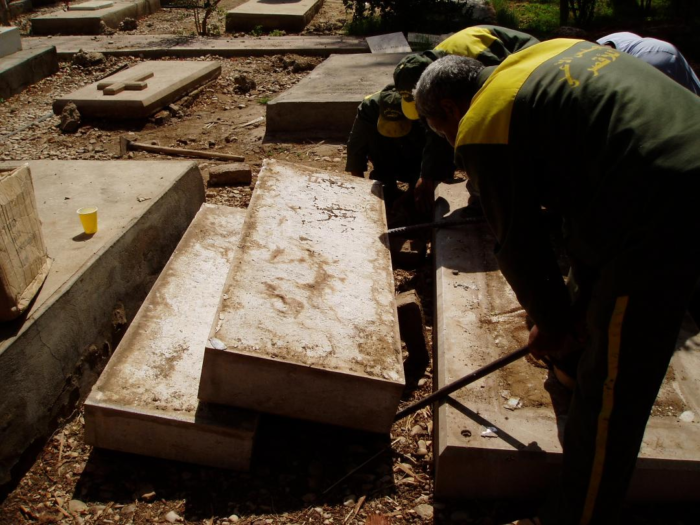
There was an excavator to dig the new graves at the desert site, but nothing suitable for shifting the large monuments at the old one. A fork-lift was brought to the foreigner’s cemetery, but it was designed for smooth concrete warehouse floors. It could not get through the gateway, let alone up the two-inch step into the cemetery. In the end the men levered the heavy granite memorials off the graves by hand, using whatever metal bars they could find.


Protective equipment was handed out to the workmen on the first day. It was never seen again. From then on they worked without gloves, masks or anything else, opening graves that in some cases had been closed for a hundred years.
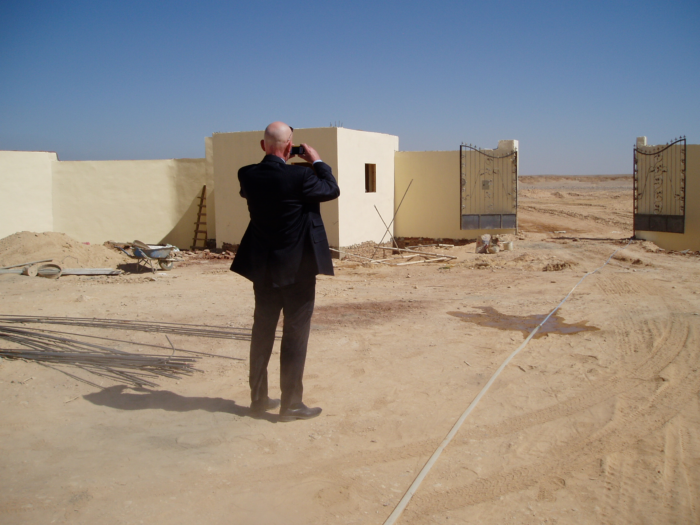
Peter met the Governor often, either when Farag came to see the work on site or when he was summoned to the Governor’s office in the evenings. He found him easy to get on with, and he clearly had the Governor’s confidence to solve his cemetery problem for him.
A couple of relatives of the deceased got in touch by email, understandably anxious. Once the process was explained to them, how their family member would be moved and where they would rest, they seemed satisfied.
Thanks to Peter’s expertise, Ehab’s local knowledge, the Governor’s men and some thinking outside several boxes, the many and varied “residents” of the foreigners’ cemetery were moved and re-interred with due respect and ceremony. And they were moved within the deadline.
A Ceremony I Never Saw
Diplomatic life has its own timetable, and it pays no attention to cemeteries. By the time the whole project was completed, I had been posted away from Cairo to Senegal. So although I had walked both the old cemetery and the new one, I was not present for the final ceremony at the new site that marked the end of the work.
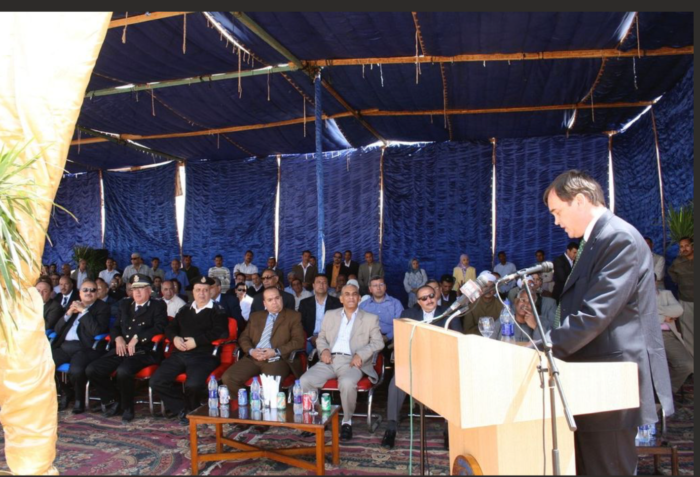
The British Ambassador did attend, and he gave his speech in Arabic, which went down very well indeed with the Egyptian guests. Visiting dignitaries showed suitable interest and decorum at the new cemetery.
The Governor had asked Peter’s advice on holding the event, and had even asked him to draft his speech. Peter told me afterwards that, listening to the Governor, he heard his own words coming back at him, expertly grafted together with suitable phrases of Farag’s own. It seemed a fitting end: a British contractor’s words in an Egyptian General’s mouth, at a cemetery for Europeans in the Egyptian desert.
A year later, in 2010, Peter went back to Luxor with his wife and daughter to see both cemeteries again. The transformation of the new cemetery was remarkable; it looked really good. The old site was another story. Far from being swallowed up by construction, it looked like some sort of Disney garden, with no sign of any imminent building work at all.
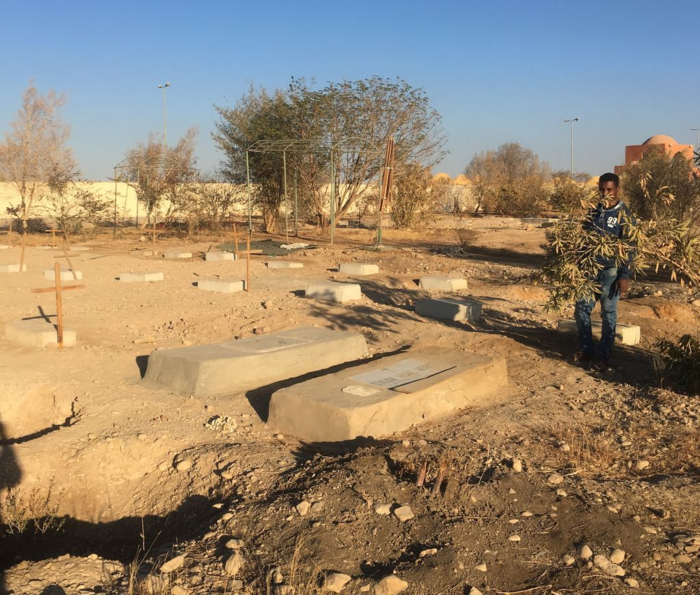
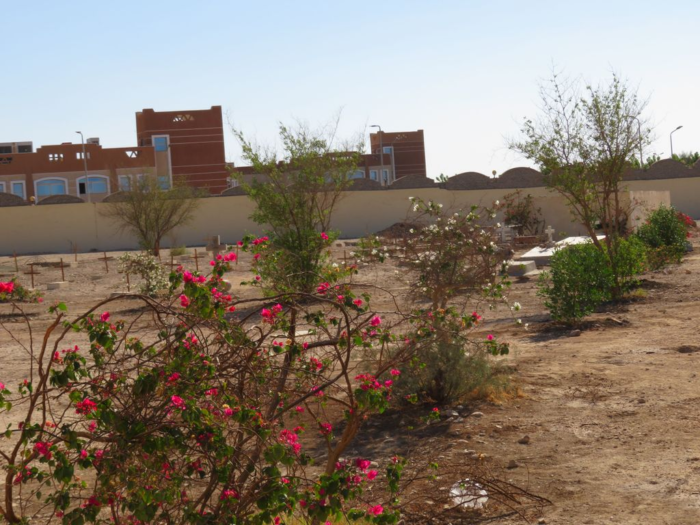
The new cemetery at Tiba is still in use today as the burial ground for foreigners who die in Luxor, and visitors still seek out its graves. The people who once lay beside the Nile now rest out in the desert, a long way from the temples they came to see.
I never saw the work done, and I never saw the ceremony. But of all the strange tasks that crossed my desk in a diplomatic career, few were stranger. An unusual and very unique task, and not one covered in any consular handbook!
© Copyright 2026 James Warren
© All images unless stated otherwise are taken from the author’s personal collection