Background
During my three years serving in North Korea, Air Koryo was our only regular link for courier trips to Beijing, but for whatever reason Air Koryo became unavailable, what could we do? The bags still had to go out and we also needed to have return bags from our embassy in Beijing.
There were no other airlines we could use, so after a brainstorming session we decided if we could try the railway option as we knew there was a regular service between Pyongyang and Beijing. But, because this was North Korea, this was a decision we could not take unilaterally. As it was so unusual for our embassy to ask to use the train instead of Air Koryo, we first had to get permission from the North Koreans, another long, arduous procedure, underscoring the tight control they North Koreans exerted over travel within the country.
The North Korean authorities were always suspicious whenever we tried something new, and a foreign diplomat wanting to ride the length of their west coast with a sealed bag was very new indeed. When the permission finally came through, I jumped at it. The bag would go with me, the journey would take me overnight rather than ninety minutes by air, and I would see the stretch of the country that most foreigners only ever looked down on through a scratched aircraft window, experiencing the realities of life in North Korea..
Packing for the Journey
Preparing for the trip was half the adventure. There was no dining car on the North Korean train, so whatever I was going to eat and drink between Pyongyang and the Chinese border, I had to bring with me. Therefore, I set off with a bag of provisions and enough bottled water to see me through, packed with the same care I gave to all the official paperwork that I would need.
Courier duty brings its own rules. The diplomatic bag does not leave your sight, so I had booked a whole compartment to myself. The authorities knew exactly who I was and what I was carrying, and nobody else was allowed in. It made for a strangely solitary journey. I could hear voices and footsteps in the corridor, but for the whole run up the coast I never met a single fellow traveller.
My only companions were the bag, my supplies and the view from the window.
Departure from Pyongyang Station
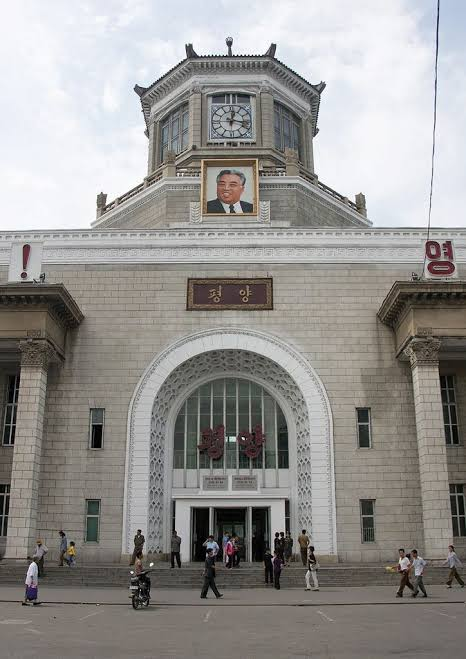
Pyongyang Station on a Thursday morning was extremely busy although as usual, a study in order. The big clock, the portraits looking down from the façade, the railway staff in their uniforms, and a platform swept cleaner than any I have seen in London. The international carriages bound for Beijing sat a little apart, as if to make the point that this was a different kind of journey. After going through the usual, long process of checking in, I was escorted to the train and shown my carriage which I quickly boarded. I found my compartment and stowed my luggage and the bag where I could see it, and waited for the train to move.
The compartment itself was pretty much a standard one, no frills or extras supplied just because I was foreigner. So, I unpacked my rations and a good book I had brought to pass the hours to come. At least the compartment was ready for the night ahead, with pillows and a couple of blankets already provided.
Up the West Coast
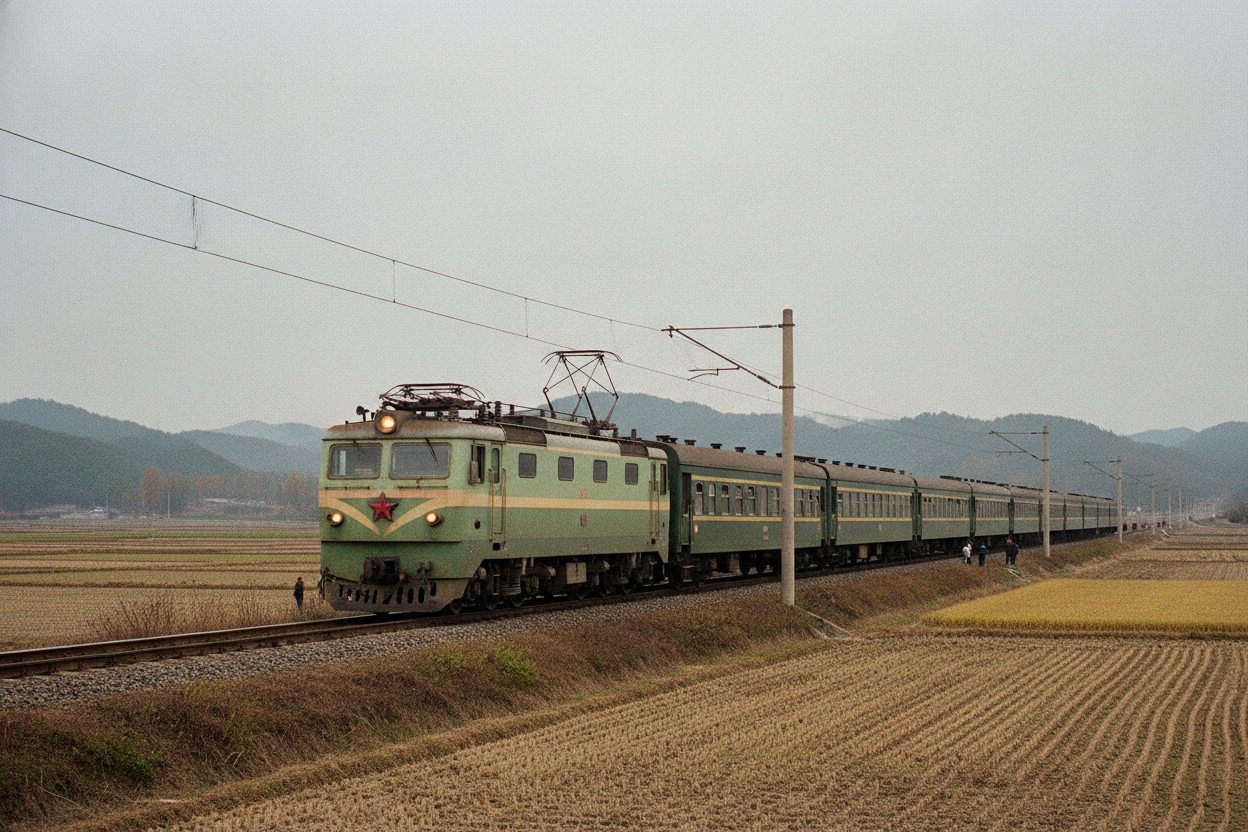
Finally, we were off. Once the suburbs fell away, the train settled into an unhurried, steady pace which it maintained for the whole North Korean part of the trip.
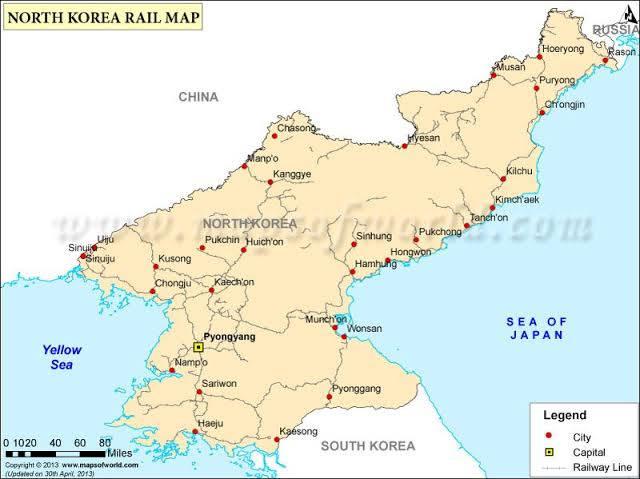
Doing my research beforehand, I found that the Pyongyang up to the border Sinuiju leg of my trip was roughly 225 km, and the train usually took about 5 to 6½ hours. Timetables had put the international service at approximately 6h 30m, North Korean trains notoriously ran late, and with delays the journey could stretch to 7-8 hours. One also had to bear in mind that a train held at the border for formalities could make the total time look longer than the actual travel. Therefore, estimating arrivals and departures was very much in the lap of the Gods.
Another reason for the slowness of the train was that the line was mostly single track, with a small number of double-track sections spaced along the route.
At The Border
We rolled north through the farmland of South Pyongan and on towards the border at Sinuijuj . Paddy fields ran almost to the tracks, cut into neat terraces wherever the ground rose. People were working them by hand, with an ox here and there, and the occasional tractor so old it looked as if it had come off a propaganda poster.
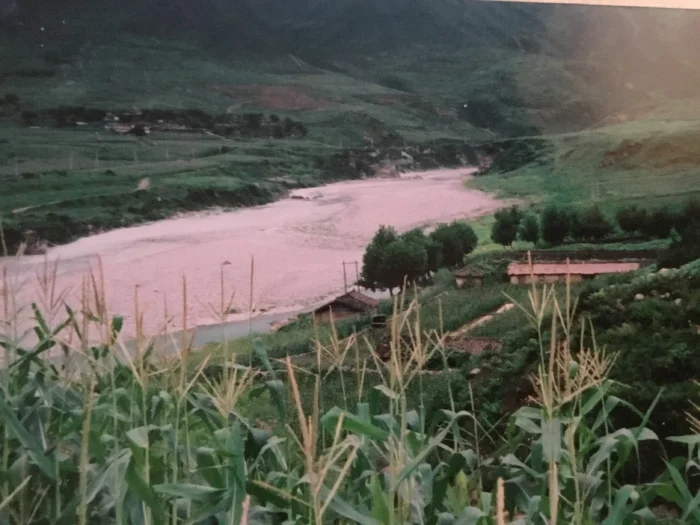
Children walked along the embankments and stopped to watch us pass; some waved, most just stared. Villages of low, whitewashed houses with tiled roofs sat in tidy rows, each with its slogan board or its mosaic of the leader.
The hours rolled by. I ate from my supplies, read some of my book, had the occasional catnap or watched the country go by. According to the timetable, we were supposed to make a stop at Chongdu, but for whatever reason the train did not stop and kept on travelling towards Sinuiju.
So, it was late in the afternoon when the train finally pulled into Sinuiju station. Here, I waited expectantly for the border checks. The stop for the North Korean border formalities lived up to expectations as to length of time these checks took. They lasted about two hours. Uniformed officials and armed border guards worked their way along the train, checking documents and going through luggage. A diplomatic passport and a sealed bag spare you the worst of it, but they don’t make you invisible. I sat in my compartment with the bag beside me and a fixed, pleasant expression on my face until they had finished going through my paperwork.
Then, at last, a jolt, and we were moving again, slowly, onto the bridge.
Across the Yalu
Crossing the Yalu on the Sino-Korean Friendship Bridge is one of those moments that stays with you. Off to one side stands the old Broken Bridge, bombed during the Korean War and left to end in mid-river, a ruin turned into a monument. Behind you, the Korean bank: dim, low, quiet.
Ahead, Dandong: tower blocks, advertising hoardings, traffic, cranes, the riverside promenade lit up like a fairground.
It takes only a few minutes to cross, but it feels like travelling decades. I have flown out of Pyongyang many times, and you never really feel the contrast from the air. You do on that bridge. It is a few hundred metres of steel between two worlds, and alone in my compartment I watched every one of them go by.
Dandong and the Chinese Side
Dandong brought another round of border and custom formalities, this time Chinese, brisker and more businesslike. Here the carriages from Pyongyang were shunted and coupled onto a Chinese train for the onward run. Through the window, China arrived all at once: bright lights, busy platforms, people on their phones, shops and stalls.
After the quiet of the Korean side, it was almost overwhelming.
Through the Night to Beijing
From Dandong the line ran west through Liaoning, through Shenyang, its lights stretching to the horizon, then on through the night towards Shanhaiguan, where the Great Wall runs down to the sea, and past Tianjin.
I made up a bed with the pillows and blankets and slept in fits, the bag close by, waking at each station stop to the clatter of carriages and the noise of the platforms.
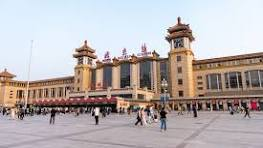
By the time the grey early morning came up, the fields had given way to the endless suburbs of the capital. Finally, early on Friday morning we eased into Beijing Station.
Journey’s End, and the Way Back
A driver from our embassy was waiting for me at the station. He took me straight to the embassy, where I handed over the diplomatic bag for onward despatch to London and, with it, the responsibility I had been carrying since Pyongyang.
It is hard to describe how light you feel at that moment.
Then, as on every courier run, I spent the weekend in a hotel in Beijing. After the long hours on the train, the city felt louder and brighter than ever. Before I left on the Monday, I collected another diplomatic bag from the embassy, this one meant for us in Pyongyang, and flew home the usual way on Air Koryo, back to the infamous on-board mystery burger and the patriotic music.
Why It Stays With Me
The normal courier flight would have had me in Beijing in a couple of hours. What the train gave me instead was the country itself: the farmers in the paddies, the children on the embankments, the two long hours in Sinuiju, and that unforgettable crossing of the Yalu, all of it seen alone from my own compartment with a bag of provisions at my feet.
It was the slowest courier run I ever made, and by some distance the most memorable.
As far as I know, the test run was never repeated, and every courier run after it went back via Air Koryo. Very few foreigners ever made that trip, and I only made it once. I’m glad I did.
© Copyright 2026 James Warren